
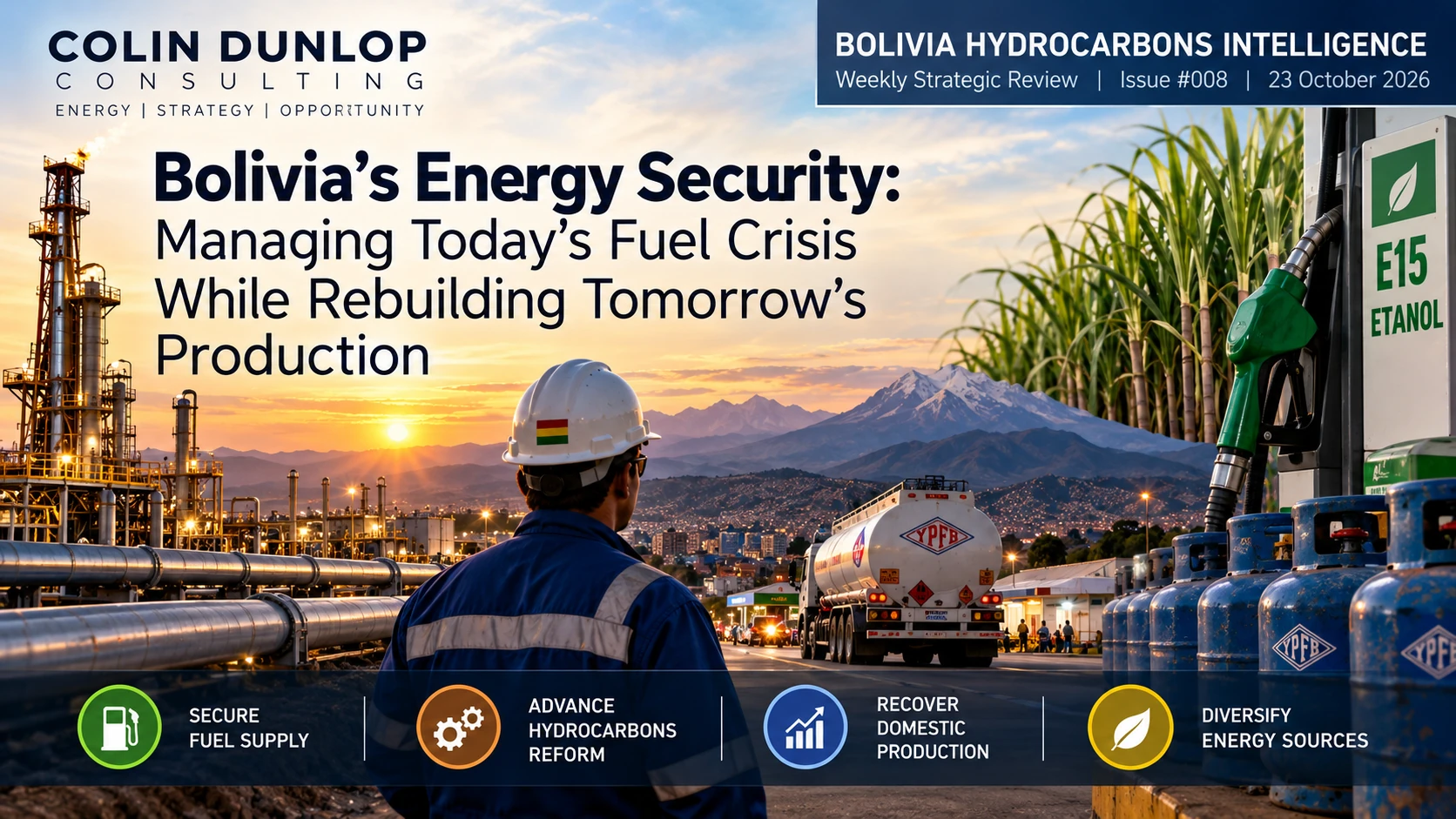
Weekly Strategic Review | Issue #008 | 23 October 2026
Bolivia’s Energy Security: Managing Today’s Fuel Crisis While Rebuilding Tomorrow’s Production
Bolivia’s latest energy developments expose a fundamental strategic challenge: the country must manage immediate fuel-supply pressures while creating the conditions for sustained investment in domestic hydrocarbon production.
1. Two energy challenges, two different timescales
Bolivia’s energy sector is confronting two closely related problems.
The first is immediate: maintaining reliable supplies of gasoline, diesel and LPG to households, industry, agriculture and transportation.
The second is structural: reversing the long-term decline in domestic hydrocarbon production and rebuilding the reserves and productive capacity needed to reduce dependence on imported fuels.
These problems require different responses.
Distribution controls, import logistics, alternative fuel blending and price adjustments may help manage short-term shortages.
But they cannot substitute for investment in exploration, field development and production recovery.
Conversely, new upstream investment will not resolve tomorrow morning’s shortage at a filling station.
Bolivia needs to manage both timescales simultaneously.
This distinction became particularly visible during the week ending 23 October.
2. The proposed Hydrocarbons Law moves closer — but the details remain decisive
On 22 October, Minister of Hydrocarbons and Energy Marcelo Blanco indicated that the proposed hydrocarbons legislation was approaching the final stages of government review.
The proposed reform is intended, among other objectives, to encourage greater private investment.
This follows earlier announcements concerning possible accelerated legislative mechanisms for hydrocarbons projects.
The direction is encouraging.
However, investors will ultimately judge the legislation against a relatively straightforward set of commercial requirements.
Will it provide internationally competitive fiscal terms?
Will investors have sufficiently secure contractual rights?
Can companies obtain approvals within predictable periods?
Will foreign exchange, financing and profit repatriation arrangements be workable?
And can projects generate returns appropriate to their geological, technical and commercial risks?
Until the legislation is published, these questions remain unanswered.
A proposed reform is an investment signal. A bankable contractual framework is an investment proposition.
Bolivia needs to move from the first to the second.
3. The ethanol agreement: A useful response, but not an upstream solution
On 19 October, the Government, YPFB and representatives of the sugar and ethanol industries signed an agreement to increase ethanol blending in gasoline.
The announced schedule envisages:
- Increasing ethanol content to 15% from 1 November 2026, subject to the necessary technical, economic, financial and regulatory requirements.
- Increasing the blend to 18% from 1 April 2027.
The initiative is intended to substitute part of the imported gasoline requirement with domestically produced ethanol.
Strategically, this makes sense.
Bolivia possesses an established sugarcane industry and associated ethanol-production capabilities, particularly in Santa Cruz.
Increasing domestic ethanol utilisation could potentially reduce gasoline-import volumes, support local agricultural production and retain a greater proportion of fuel-related expenditure within the Bolivian economy.
However, several qualifications are important.
First, ethanol blending reduces the volume of conventional gasoline required; it does not eliminate the need for petroleum-derived fuels.
Second, ethanol has a lower volumetric energy content than gasoline. Consequently, the reduction in imported gasoline volumes does not translate directly into an equivalent reduction in total energy consumption.
Third, higher blending levels require appropriate fuel specifications, quality assurance, vehicle compatibility and distribution controls.
The agreement is therefore a potentially useful component of energy diversification.
But it should not be confused with a solution to declining domestic crude oil and natural gas production.
4. LPG distribution problems highlight the importance of operational reliability
The week’s LPG developments provide another illustration of Bolivia’s immediate energy-security challenges.
YPFB reported intensified distribution and enforcement operations following complaints of irregular accumulation, resale at excessive prices and suspected diversion of LPG cylinders.
On 22 October, the company reported dispatching approximately 43,000 ten-kilogram LPG cylinders to consumers in La Paz and El Alto.
The official retail price remained Bs 22.50 per cylinder.
YPFB maintained that sufficient stocks were available, while acknowledging the need to reinforce distribution and controls.
This distinction matters.
A shortage experienced by consumers may arise from several different causes:
- Insufficient production or import supply.
- Inadequate storage or transportation capacity.
- Distribution interruptions.
- Price distortions.
- Illegal diversion or speculative accumulation.
- Operational or administrative failures.
These causes require different remedies.
A country may have sufficient product in storage and still experience serious localised shortages if its distribution system fails.
Similarly, improving distribution will not solve a structural decline in domestic LPG production.
Energy security requires both adequate physical supply and a reliable system for delivering it.
5. The connection to Bolivia’s upstream production decline
The immediate fuel-supply challenges reinforce a broader concern.
Bolivia’s hydrocarbons system was developed during a period when substantial natural gas production supported domestic consumption, exports and the recovery of associated liquids.
As gas production declines, the implications extend beyond export revenue.
Lower production can also affect the availability of condensate, natural gasoline and LPG feedstocks, depending on the composition of individual fields and processing arrangements.
This makes the recovery of domestic hydrocarbon production strategically important.
For Bolivia, incremental liquids production has potential value beyond the revenue generated by the producing field.
Where the appropriate processing and refining infrastructure is available, additional domestic liquids may help substitute imported feedstocks or finished fuels.
However, the economic benefit must be evaluated carefully.
Not every barrel of produced liquid is equivalent.
Condensate, crude oil, natural gasoline and LPG have different properties, processing requirements and commercial values.
Nor does every additional barrel necessarily translate into an equivalent reduction in fuel imports.
The relevant question is how each production opportunity contributes to the national supply balance after accounting for processing, transportation, product yields and costs.
6. Mature-field rehabilitation deserves renewed attention
This is where Bolivia’s inventory of mature and underperforming fields becomes particularly interesting.
A mature-field rehabilitation project may involve substantially less geological uncertainty than frontier exploration.
Existing wells, reservoir information, production histories and infrastructure can provide a starting point for technical evaluation.
Potential interventions include:
- Reactivation of shut-in wells.
- Workovers and recompletions.
- Artificial-lift improvements.
- Water-handling optimisation.
- Infill drilling.
- Reservoir-pressure management.
- Rehabilitation of surface facilities.
Some opportunities may offer relatively short development cycles.
Others may prove technically difficult or commercially unattractive.
The key is systematic screening.
A credible mature-field investment programme should evaluate recoverable volumes, production profiles, capital requirements, operating costs, infrastructure constraints and commercial terms.
It should also identify the appropriate investor or operator for each opportunity.
Specialist independent petroleum companies may be better suited to certain mature-field projects than large international exploration companies.
The objective should be to match each asset with the capital, technology and operating model most capable of unlocking its value.
7. Bolivia needs an integrated energy-security strategy
The developments of this week suggest that Bolivia’s energy policy should be considered across three complementary horizons.
Immediate: Secure supply
Maintain adequate imports and inventories, strengthen distribution reliability, improve transparency and address illegal diversion.
Medium term: Recover production
Accelerate technically and commercially viable projects in mature fields, existing developments and known discoveries.
This is where targeted investment and specialist operating capabilities may deliver relatively early results.
Long term: Rebuild reserves
Establish competitive conditions for exploration, appraisal and larger-scale development projects.
These investments will be essential if Bolivia is to rebuild sustainable productive capacity rather than simply slow the rate of decline.
The three horizons are interconnected.
A successful short-term fuel strategy creates breathing space.
Medium-term production recovery can reduce pressure on imports.
Long-term exploration and development establish the foundations for future energy security.
No single measure can replace the others.
8. The commercial opportunity for international investors
Bolivia’s energy-security challenge could create opportunities across several segments of the petroleum industry.
For independent operators, mature-field rehabilitation and redevelopment may provide entry opportunities involving relatively modest capital commitments.
For larger operators, exploration and development opportunities may become attractive if the proposed reforms establish competitive contractual and fiscal conditions.
For international oilfield service companies, renewed activity could create demand for drilling, workovers, well intervention, reservoir management and production technologies.
However, these opportunities will not become investable merely because Bolivia needs additional production.
They must be supported by credible technical data, clearly defined commercial rights, reliable infrastructure and an acceptable allocation of risk.
International investors will also need confidence that contractual commitments can be implemented in practice.
This is why the pending hydrocarbons legislation matters.
Its success will ultimately be measured not by the ambition of its language, but by the projects it enables.
What actually changed this week
Three developments stand out.
First, the proposed Hydrocarbons Law moved closer to publication, according to the Minister, although the detailed commercial framework remains unavailable.
Second, the Government reached an agreement to increase ethanol blending, potentially reducing part of the country’s conventional gasoline-import requirement.
Third, renewed LPG distribution difficulties demonstrated the continuing importance of reliable logistics, appropriate pricing and effective market oversight.
Individually, these developments concern different parts of the energy industry.
Collectively, they illustrate the need for an integrated strategy linking supply security, fuel diversification and upstream production recovery.
Strategic implication
Bolivia’s energy-security problem cannot be solved exclusively through imports, distribution controls or alternative fuels.
Nor can it be solved simply by passing new hydrocarbons legislation.
The country needs a coordinated programme that addresses immediate fuel requirements while restoring the commercial conditions necessary to attract upstream investment.
This should include a credible portfolio of mature-field, development and exploration opportunities, matched with appropriate international capital and operating capabilities.
For investors and service companies, the opportunity lies in identifying where Bolivia’s strategic energy requirements coincide with commercially viable projects.
For policymakers, the challenge is creating conditions in which those projects can proceed.
Energy security is ultimately an investment, infrastructure and execution challenge — not simply a fuel-supply problem.
What to watch next
Hydrocarbons legislation: Publication of the proposed law, particularly its fiscal terms, contractual structures and investment-approval mechanisms.
Ethanol implementation: Completion of the necessary evaluations, supply agreements and regulatory steps before the proposed 1 November increase.
LPG supply: Whether the strengthened distribution and enforcement measures restore reliable availability without continuing disruptions.
Domestic production: Evidence of additional investment in mature fields, liquids recovery and development of known accumulations.
International participation: Binding investment commitments, operator agreements and mobilisation of specialist oilfield services.
Conclusion
Bolivia’s energy sector is entering a period in which short-term operational pressures and long-term structural reform are increasingly intertwined.
The country must secure today’s fuel supplies while rebuilding the production capacity required for tomorrow.
Higher ethanol blending may reduce part of the gasoline-import burden.
Better distribution and enforcement may improve the reliability of LPG supplies.
And a competitive hydrocarbons framework could help attract the capital required to restore upstream investment.
But the most durable improvement will come from turning technically credible opportunities into commercially viable projects and additional domestic production.
Bolivia must manage today’s fuel crisis without losing sight of the investment decisions that will determine its energy security for the next decade.
Resumen en español
La seguridad energética de Bolivia exige atender el abastecimiento actual y recuperar la producción futura.
Durante la semana del 19 al 23 de octubre se registraron tres acontecimientos importantes para el sector energético boliviano.
Primero, el ministro de Hidrocarburos y Energías informó que el proyecto de nueva Ley de Hidrocarburos se encuentra en su etapa final de revisión, con el objetivo de promover una mayor inversión privada.
Segundo, el Gobierno, YPFB y el sector sucroalcoholero acordaron incrementar la mezcla de etanol en la gasolina al 15% desde noviembre de 2026, sujeto a las evaluaciones y disposiciones correspondientes, y posteriormente al 18% desde abril de 2027.
Tercero, los problemas de distribución de GLP, especialmente en La Paz y El Alto, obligaron a YPFB a reforzar sus operaciones logísticas y los controles contra el acopio irregular y la especulación.
Estos acontecimientos muestran que Bolivia enfrenta dos desafíos simultáneos: garantizar el abastecimiento inmediato de combustibles y recuperar la producción nacional de hidrocarburos.
La diversificación energética y una mejor logística pueden contribuir a reducir las presiones de corto plazo.
Sin embargo, la solución estructural requiere inversiones en campos maduros, recuperación de pozos, desarrollo de yacimientos conocidos y nueva exploración.
Para lograrlo, Bolivia necesita condiciones contractuales competitivas, seguridad jurídica, acceso a capital y capacidad técnica y operativa.
La verdadera seguridad energética dependerá de la capacidad del país para convertir sus recursos y oportunidades en proyectos financiados, ejecutados y productores.
Bolivia Hydrocarbons Intelligence is an independent strategic analysis publication by Colin Dunlop Consulting, examining developments affecting Bolivia’s hydrocarbons sector, investment environment and upstream opportunities.
Colin Dunlop
Petroleum Engineer & Project Manager
Colin Dunlop Consulting | Santa Cruz, Bolivia
Sources
- Opinión / Urgente.bo — Government finalises Hydrocarbons Law and advances energy diversification, 22 October 2026
- YPFB — Official press releases, 19–22 October 2026
- Bolivia TV — Agreement to increase ethanol blending, 19 October 2026
- Los Tiempos — LPG distribution and ethanol developments, 20–22 October 2026
- Chambers and Partners — Oil & Gas 2026: Bolivia, legal and investment outlook