
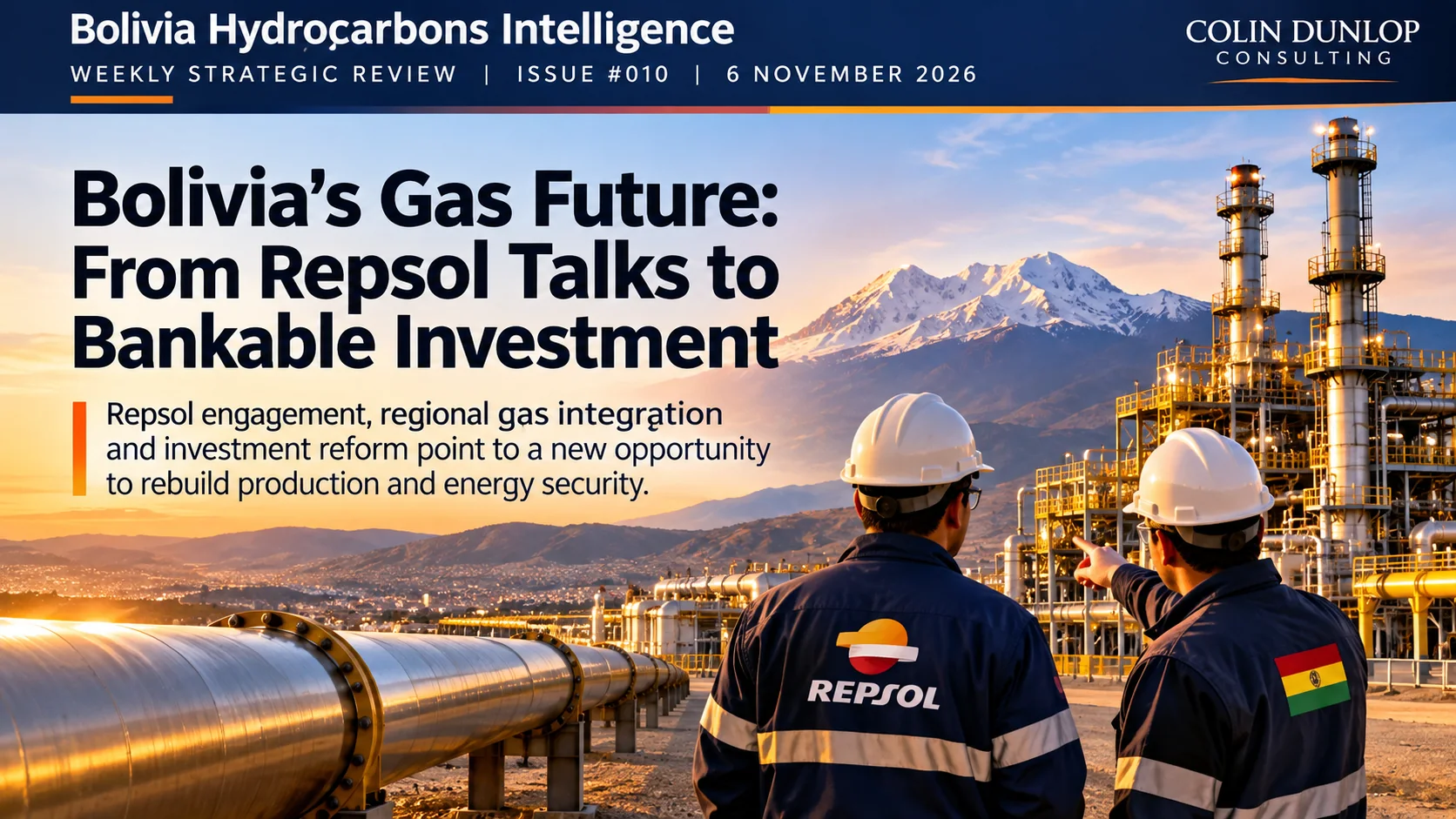
Bolivia Hydrocarbons Intelligence | Weekly Strategic Review | Issue #010 | 6 November 2026
Bolivia’s Gas Future: From Repsol Talks to Bankable Investment
Bolivia’s renewed engagement with Repsol, its regional gas-transit ambitions and its proposed investment reforms point toward a potentially important transition. The challenge is converting political and commercial interest into financed projects, drilling programmes and additional production.
1. This week’s signal: Repsol and the return of investment diplomacy
On 4 November, President Rodrigo Paz met Repsol Chairman Antonio Brufau in Madrid during the XXX Ibero-American Summit.
The meeting focused on energy cooperation and potential investment in Bolivia’s hydrocarbons sector.
President Paz subsequently announced that Repsol representatives would make an official visit to Bolivia.
The Government presented the encounter as evidence of a renewed relationship with international investors and a commitment to creating greater certainty for the petroleum industry.
The announcement deserves attention.
Repsol is not a prospective newcomer to Bolivia. It is an established upstream participant, with substantial experience in the country’s gas-producing basins and existing interests in major producing assets.
Its operations include participation in the Caipipendi block, encompassing Margarita-Huacaya, as well as an important shareholding in YPFB Andina.
This distinction matters.
Bolivia may be able to accelerate investment more effectively by expanding the activities of established operators than by relying exclusively on attracting entirely new companies.
Existing operators already possess geological knowledge, operating experience, infrastructure access and relationships with the national petroleum industry.
These advantages can reduce some of the technical and institutional barriers associated with new investment.
However, the Madrid meeting should not yet be interpreted as an investment commitment.
No specific new upstream project, capital allocation, binding agreement or drilling timetable was announced.
The significance of the meeting is therefore strategic rather than transactional.
It creates an opportunity for substantive commercial negotiations.
Whether those negotiations result in additional production remains to be seen.
2. Existing operators could provide the fastest route to new investment
Bolivia’s hydrocarbons recovery requires several categories of investment.
Frontier exploration remains essential for rebuilding reserves over the longer term.
But exploration projects typically involve substantial geological uncertainty, significant capital exposure and lengthy development cycles.
Existing producing areas offer a different investment proposition.
Operators with established geological databases and infrastructure may be able to identify opportunities involving:
- Infill drilling and development of known reservoirs.
- Appraisal of discovered but undeveloped accumulations.
- Production enhancement and reservoir optimisation.
- Workovers and recompletions.
- Additional compression or facilities improvements.
- Development of satellite accumulations using existing infrastructure.
Not every opportunity will be commercially viable.
Mature reservoirs may present declining pressures, increasing water production, complex compartmentalisation or substantial additional investment requirements.
Nevertheless, the availability of historical production data and existing infrastructure can materially improve project screening.
For Bolivia, this suggests a practical investment strategy.
Encourage established operators to identify and rank their most commercially attractive incremental projects while simultaneously opening the sector to specialist independent companies.
The two approaches are complementary.
Major operators may be best positioned to expand complex gas developments.
Smaller independent operators may be more effective in certain mature-field rehabilitation and short-cycle production projects.
The objective should be to match each opportunity with the appropriate capital, technology and operating model.
3. The new Hydrocarbons Law remains the critical commercial test
During the week, the Government continued presenting its proposed legal reforms as a foundation for renewed investment.
The administration’s international investment agenda included hydrocarbons, mining, industrial development and broader improvements to legal certainty.
However, the detailed commercial provisions of the proposed Hydrocarbons Law had not been publicly established by 6 November.
This remains the central uncertainty.
International petroleum companies do not invest simply because a government expresses support for foreign capital.
They evaluate the complete investment proposition.
For Bolivia, the decisive questions include:
Fiscal competitiveness: Will taxation, royalties and other fiscal obligations allow commercially attractive risk-adjusted returns?
Contractual security: Will investors receive sufficiently clear, enforceable and durable rights?
Project approvals: Can contracts and development programmes be approved within predictable timeframes?
Foreign exchange: Can investors obtain foreign currency and repatriate legitimate profits and capital?
Operational execution: Can companies mobilise drilling equipment, technology, services and personnel efficiently?
Commercialisation: Are gas sales, transportation access and payment arrangements sufficiently reliable to support financing?
A competitive framework must address these questions together.
An attractive fiscal regime cannot compensate indefinitely for uncertain approvals.
Similarly, faster approvals will have limited value if project economics remain uncompetitive.
The strongest reform would therefore combine competitive commercial terms with transparent procedures and measurable approval timelines.
The measure of success will not be the announcement of a new law. It will be the number and quality of investment decisions that the law enables.
4. Bolivia’s regional gas infrastructure remains a strategic asset
A second important development occurred on 3 November, when YPFB reported progress in regional gas-integration discussions involving Argentina, Bolivia and Brazil.
The announcement followed a working meeting held in Buenos Aires on 27 October under the Mercosur regional gas-integration initiative.
YPFB indicated that the participants were advancing technical, regulatory and commercial priorities for the movement of Argentine natural gas through Bolivia to Brazilian markets.
Particular attention was given to the 2026–2027 summer period and longer-term regional arrangements.
The commercial significance is substantial.
Bolivia’s historical position as a major natural gas exporter resulted in the development of pipeline infrastructure connecting important South American energy markets.
Although domestic gas production has declined, much of that infrastructure retains potential strategic value.
YPFB has identified the opportunity to position Bolivia as a regional gas-transit corridor, using existing pipelines and compression facilities to connect Argentine supply with Brazilian demand.
This could provide a supplementary commercial role for Bolivia’s gas industry.
Rather than relying exclusively on revenues from domestically produced gas, Bolivia could potentially generate additional value through transportation and related services.
However, transit revenues are not equivalent to upstream production revenues.
The economic model depends on transportation tariffs, available capacity, compression costs, contractual arrangements, regulatory approvals and sustained commercial demand.
The opportunity therefore requires detailed commercial evaluation.
Bolivia’s gas infrastructure may remain valuable even as the country’s domestic production profile changes.
But developing a regional transit business must complement, rather than replace, efforts to restore domestic production.
5. The distinction between gas transportation and gas production
Bolivia’s emerging gas-transit strategy creates an important distinction for investors.
An upstream investment is fundamentally an investment in geological resources, reservoir performance and hydrocarbon production.
A gas-transportation investment is primarily an infrastructure and commercial-throughput proposition.
The risk profiles are different.
Upstream investors evaluate reserves, production forecasts, capital expenditure, operating costs, fiscal terms and commodity-price exposure.
Pipeline investors and operators focus on contracted volumes, tariffs, capacity utilisation, operating reliability and counterparty creditworthiness.
For Bolivia, both activities could contribute to economic recovery.
But they should be evaluated separately.
A commercially successful transit corridor could provide useful revenue and strengthen regional energy integration.
It would not, by itself, reverse declining Bolivian gas reserves.
Nor would it necessarily create additional domestic liquids production.
The distinction becomes particularly important when assessing national energy security.
Transporting more gas through Bolivia is not the same as producing more gas in Bolivia.
Both may be desirable, but they solve different problems.
6. Electricity infrastructure highlights the importance of investment discipline
On 5 November, the Ministry of Hydrocarbons and Energy, ENDE and the Procuraduría General del Estado announced legal actions and investigations concerning the development of combined-cycle thermal power facilities at Entre Ríos, Termoeléctrica del Sur and Warnes.
The authorities alleged irregularities in project procurement and execution, together with excessive installed capacity relative to expected demand and available gas resources.
The Ministry reported a combined project value of approximately US$1.168 billion and significant outstanding financing obligations.
These are allegations and findings presented by government authorities. Legal responsibility has not been finally established, and the individuals concerned are entitled to due process.
Nevertheless, the announcement raises a wider strategic issue.
Major energy infrastructure investments must be evaluated against realistic forecasts of fuel availability, demand, utilisation and commercial returns.
A technically sophisticated facility is not necessarily an economically justified investment.
This is especially important in gas-dependent electricity systems.
If domestic gas production declines faster than anticipated, generation facilities may face fuel-supply constraints or changing operating economics.
Conversely, investment in additional generation capacity without sufficient contracted demand can result in underutilised assets.
For future projects, Bolivia will need stronger alignment between upstream production forecasts, transportation capacity, power-generation requirements and long-term commercial demand.
The lesson applies equally to petroleum development projects.
Capital discipline, realistic production forecasts and integrated infrastructure planning are essential to sustainable energy investment.
7. From investor meetings to bankable projects
The Repsol meeting and the Government’s broader international outreach are encouraging signals.
But Bolivia’s investment challenge is not primarily diplomatic.
It is commercial.
To translate renewed interest into productive investment, the country needs a pipeline of projects that can withstand rigorous technical, financial and legal due diligence.
For each opportunity, prospective investors will expect credible information covering:
- Geological and reservoir characteristics.
- Historical and forecast production.
- Recoverable reserves or resources, appropriately classified.
- Development options and technical risks.
- Capital and operating expenditure.
- Existing infrastructure and additional facilities requirements.
- Fiscal and contractual terms.
- Environmental and social obligations.
- Project execution schedules.
- Commercialisation and revenue arrangements.
Without this information, expressions of investor interest may not progress beyond preliminary discussions.
This creates an important opportunity for structured project development.
Bolivia needs more than a catalogue of prospective fields.
It needs a portfolio of investment-ready opportunities, supported by credible technical information and commercially realistic development plans.
For established operators, this may involve identifying incremental investment opportunities within existing assets.
For independent companies, it may involve mature-field redevelopment, farm-ins, joint ventures or specialist operating arrangements.
For international service providers, it may involve technology partnerships and performance-based production-enhancement programmes.
The common requirement is a clear relationship between investment, risk, execution and expected returns.
8. What actually changed this week
Three developments stand out.
First, Bolivia renewed high-level engagement with Repsol.
The meeting between President Paz and Antonio Brufau created an opportunity for further discussions with one of Bolivia’s most important established upstream participants.
However, no new investment commitment was publicly confirmed.
Second, YPFB advanced the regional gas-transit agenda.
The Argentina–Bolivia–Brazil corridor could create additional commercial opportunities using existing transportation infrastructure.
The initiative remains dependent on technical, regulatory and commercial arrangements.
Third, the Government raised significant concerns about historical investment decisions in gas-fired electricity generation.
The announcement reinforces the importance of aligning infrastructure investment with realistic fuel-supply forecasts and commercial demand.
Together, these developments point toward a broader conclusion.
Bolivia’s energy recovery requires not only new investment, but better investment decisions.
Strategic implication
Bolivia’s hydrocarbons industry is entering a potentially important period.
The Government is actively seeking renewed international participation.
Established operators remain strategically important.
Regional gas infrastructure offers opportunities beyond domestic production.
And proposed legal reforms could change the economics of future upstream investment.
However, the country’s central challenge remains unchanged.
Bolivia must convert its remaining geological potential, existing producing assets and infrastructure advantages into commercially viable projects capable of attracting capital and delivering measurable results.
This will require competitive legislation, credible technical evaluation, appropriate international partners and disciplined project execution.
For investors, the most attractive opportunities are likely to be those where existing infrastructure, technical knowledge and commercially viable development plans reduce uncertainty.
For Bolivia, the priority should be to transform renewed investor interest into binding commitments, financed projects and additional production.
What to watch next
Repsol’s announced visit: Whether discussions produce identifiable projects, investment amounts, technical work programmes or formal agreements.
Hydrocarbons legislation: Publication of the proposed law and its treatment of fiscal terms, contractual rights, approvals and foreign investment.
Existing operators: Evidence of additional development drilling, appraisal, production enhancement or mature-field rehabilitation.
Argentina–Bolivia–Brazil gas corridor: Progress on transportation contracts, tariffs, available capacity and regulatory coordination.
Project financing: Binding investment commitments rather than expressions of interest.
Electricity-sector investigations: Verified technical findings, financial implications and any resulting changes to energy infrastructure planning.
Conclusion
Bolivia’s meeting with Repsol was an important signal of renewed engagement with international petroleum investors.
But Repsol never left Bolivia.
The opportunity is therefore not simply to welcome an international company back.
It is to establish the conditions under which existing and prospective operators can justify committing additional capital.
At the same time, Bolivia’s gas-transportation infrastructure may provide new commercial opportunities as regional energy flows evolve.
Both developments could contribute to economic recovery.
Neither will automatically reverse the decline in domestic gas production.
That requires technically sound projects, competitive investment terms, financing and execution.
Bolivia’s next hydrocarbons breakthrough will not be another investor meeting. It will be the conversion of renewed interest into a bankable project, a binding investment commitment and ultimately additional production.
Resumen en español
Bolivia busca transformar el renovado interés internacional en inversiones concretas para recuperar su producción de hidrocarburos.
Durante la semana del 31 de octubre al 6 de noviembre de 2026, tres acontecimientos destacaron en el sector energético boliviano.
El primero fue la reunión del presidente Rodrigo Paz con Antonio Brufau, presidente de Repsol, celebrada el 4 de noviembre en Madrid. El encuentro abrió la posibilidad de nuevas conversaciones de inversión y una próxima visita oficial de representantes de la empresa a Bolivia.
Es importante recordar que Repsol nunca abandonó el país. Mantiene operaciones e intereses en importantes activos gasíferos, por lo que una eventual ampliación de sus inversiones podría aprovechar su experiencia técnica, conocimiento geológico e infraestructura existente.
Sin embargo, todavía no se anunciaron montos de inversión, proyectos específicos ni compromisos contractuales.
El segundo acontecimiento fue el avance de YPFB en la integración gasífera regional entre Argentina, Bolivia y Brasil. La infraestructura boliviana podría generar ingresos adicionales mediante el transporte de gas argentino hacia el mercado brasileño.
Esta oportunidad es comercialmente interesante, pero no debe confundirse con la recuperación de la producción nacional de gas.
El tercer acontecimiento fue el anuncio de investigaciones sobre presuntas irregularidades en inversiones realizadas en centrales termoeléctricas de ciclo combinado. Este caso refuerza la importancia de evaluar los grandes proyectos energéticos con criterios técnicos, económicos y financieros rigurosos, respetando el debido proceso en las investigaciones.
La conclusión estratégica es clara.
Bolivia necesita una nueva Ley de Hidrocarburos que ofrezca condiciones competitivas, seguridad jurídica y procesos de aprobación previsibles.
Pero también necesita transformar sus oportunidades geológicas y sus campos existentes en proyectos técnicamente sólidos y comercialmente viables.
La participación de operadores internacionales, empresas independientes y proveedores especializados puede contribuir significativamente a este proceso.
La verdadera recuperación del sector no se medirá por la cantidad de reuniones con inversionistas, sino por los compromisos de capital, los proyectos ejecutados y el incremento efectivo de la producción.
Bolivia Hydrocarbons Intelligence is an independent strategic analysis publication by Colin Dunlop Consulting, examining developments affecting Bolivia’s hydrocarbons sector, investment environment and upstream opportunities.
Colin Dunlop
Petroleum Engineer & Project Manager
Colin Dunlop Consulting | Santa Cruz, Bolivia
Sources
- Ministry of Hydrocarbons and Energy — President Paz meets Repsol Chairman Antonio Brufau, 4 November 2026
- ABI — Paz announces forthcoming official Repsol visit to Bolivia, 4 November 2026
- YPFB — Argentina–Bolivia–Brazil regional gas integration, 3 November 2026
- Ministry of Economy and Public Finance — Bolivia presents its investment agenda in Madrid, 6 November 2026
- Ministry of Hydrocarbons and Energy — Authorities announce investigations into combined-cycle thermal power projects, 5 November 2026
- El Deber — Paz seeks investment to reactivate Bolivian gas production, 5 November 2026
- El País, Tarija — Repsol’s continuing presence in Bolivia, 5 November 2026