
Weekly Strategic Review | Issue #005 | 2 October 2026
Bolivia Hydrocarbons Intelligence — 2 October 2026
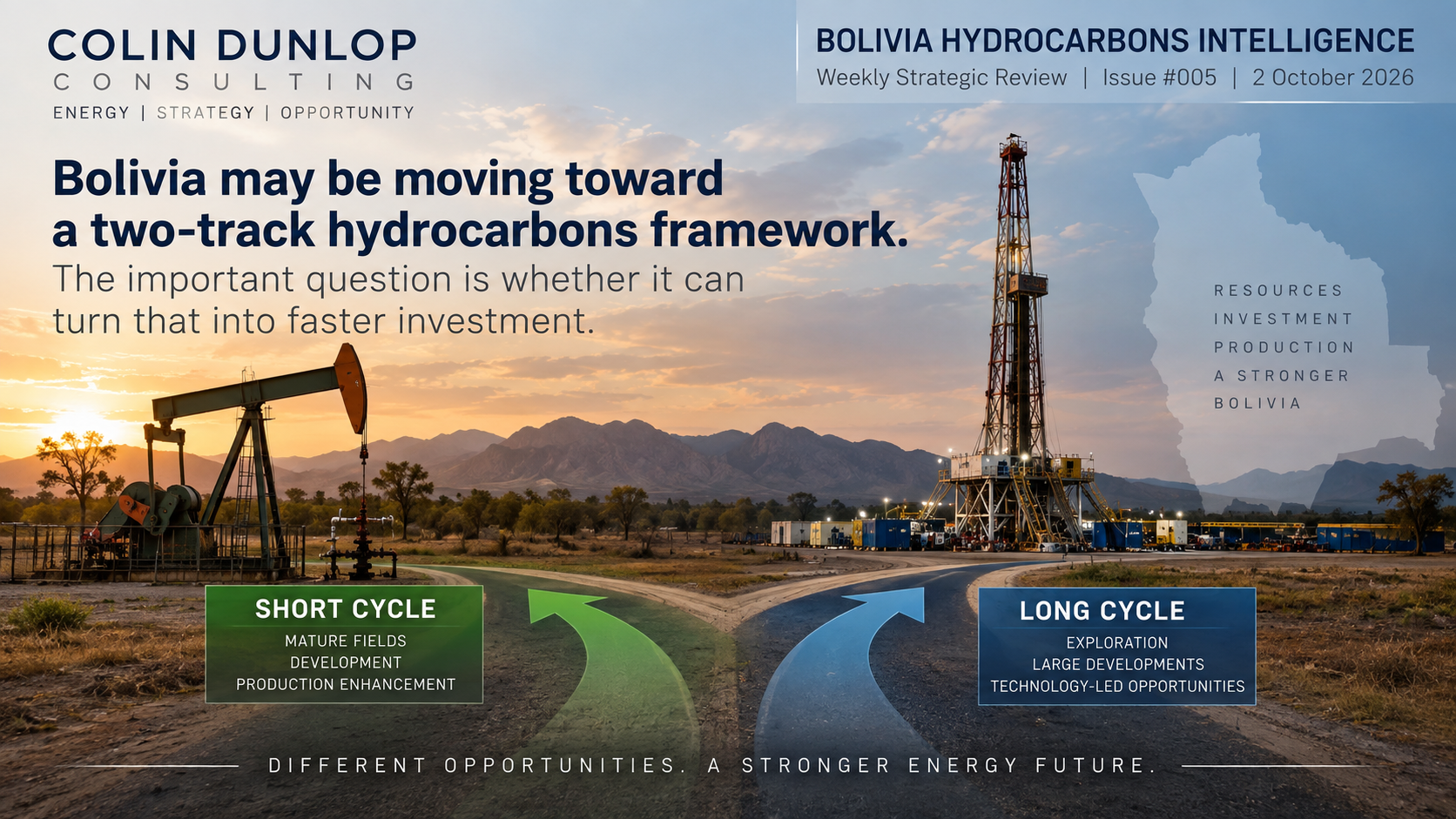
Bolivia may be moving toward a two-track hydrocarbons framework. The important question is whether it can turn that into faster investment.
Bolivia’s hydrocarbons reform may be beginning to address one of the sector’s most important structural problems:
not every petroleum project should have to follow the same investment and approval path.
On 30 September, President Rodrigo Paz announced that the Government is preparing what he described as a “long” Hydrocarbons Law and a shorter instrument intended to facilitate both major projects and smaller, faster projects.
The details have not yet been published.
That qualification is important.
It is therefore too early to know whether this represents a fundamental change in Bolivia’s upstream investment model or simply a faster legislative mechanism.
But the direction deserves attention.
Because Bolivia does not only need better fiscal terms.
It needs a system capable of moving technically and commercially credible projects from opportunity → agreement → approval → investment → production much faster than it has historically done.
1. Bolivia does not have one upstream problem
The emerging Bolivian opportunity set is increasingly diverse.
It includes:
- mature and marginal fields;
- shut-in and underperforming production;
- workovers and production enhancement;
- conventional development drilling;
- conventional exploration;
- and potentially technology-led development of low-permeability resources such as those now being tested at Montecristo-9.
These are fundamentally different investments.
A relatively modest mature-field rehabilitation programme capable of adding production within months should not necessarily face the same commercial structure, approval process and investment cycle as a large exploration programme requiring substantial risk capital.
Nor should either necessarily be treated in the same way as a potential multi-well low-permeability development.
Different projects involve different combinations of:
geological risk + capital exposure + time to production + technology + potential return.
A modern hydrocarbons framework should recognise those differences.
2. The proposed “short” route could therefore be important
President Paz has provided very little detail so far.
His description on 30 September referred to a longer Hydrocarbons Law and a shorter law intended to facilitate “megaprojects” and “short, rapid projects.”
The precise legal architecture remains unclear.
But the concept potentially addresses an issue that has repeatedly emerged in these Weekly Strategic Reviews:
project cycle time.
International capital does not evaluate a project solely on geology or headline fiscal terms.
It evaluates risk-adjusted returns over time.
An attractive petroleum opportunity that can begin investment within three months is not economically equivalent to the same opportunity waiting twelve or eighteen months for contracts, legislative approval and regulatory authorisations.
Capital has alternatives.
And capital waits at a cost.
If the proposed shorter framework can create a genuinely accelerated path for appropriate projects, it could become one of the most commercially important components of Bolivia’s hydrocarbons reform.
3. Mature fields may provide the obvious test case
Bolivia does not need to wait for another giant discovery before increasing production.
There is already an inventory of mature, marginal, shut-in and underperforming assets where relatively targeted capital and technical intervention may produce incremental barrels or gas.
Recent activity illustrates the principle.
YPFB is intervening in 11 wells in the mature Bermejo and Toro fields. Production from those fields had reportedly increased from approximately 95 b/d to around 140 b/d during the campaign, with additional interventions planned.
At Surubí-Mamoré, YPFB began drilling the Surubí Noroeste-6 development well on 23 September, targeting the Yantata and Lower Petaca reservoirs with an investment of approximately US$9 million.
Neither project will transform Bolivia’s national production profile by itself.
That is not the point.
They demonstrate that production recovery does not have to depend exclusively upon large new discoveries.
A portfolio containing dozens of technically sound production-enhancement, redevelopment and development projects could begin contributing much earlier while larger exploration and development projects progress in parallel.
For Bolivia, speed and portfolio effect may matter almost as much as project size.
4. Montecristo demonstrates the other end of the spectrum
Montecristo-9 illustrates why a single commercial model may not be sufficient.
The current programme is testing the production potential of low-permeability Devonian reservoirs using specialised stimulation technology.
It remains a pilot.
The results still need to establish sustainable production rates, pressure behaviour, decline characteristics and ultimately the economics of repeatable commercial wells.
But YPFB Chaco has already outlined a much larger conceptual opportunity involving approximately 90 wells, around US$1.6 billion of investment and potential production at scale of approximately 110 MMcf/d of gas and 12,000 b/d of liquids.
That is an entirely different investment proposition from rehabilitating several existing mature-field wells.
It requires substantially more capital.
It carries different technical risks.
It requires specialist technology and service capability.
It potentially involves different environmental and social considerations.
And it will require an investment structure capable of attracting substantial external capital.
Trying to accommodate both opportunities under a rigid one-size-fits-all commercial framework would make little sense.
5. The real test is not whether Bolivia passes another law
Bolivia has discussed hydrocarbons reform for months.
The important measure of success will not be the number of pages in the new legislation.
It will be whether credible projects become easier to invest in.
For an international operator or investor, the practical questions are straightforward:
What rights do I receive?
What return can I earn?
How stable are the fiscal and contractual terms?
Can capital and profits be repatriated?
How quickly can agreements and approvals be obtained?
Who regulates the project?
Can the required equipment, services and personnel be mobilised?
And how quickly can capital begin generating production and cash flow?
If the new framework answers those questions competitively and predictably, Bolivia’s investment proposition changes materially.
If it does not, changing the legislation alone will not bring significant international risk capital back.
6. Speed must not mean lower standards
There is an important distinction.
A faster approval process does not need to mean weaker technical, environmental or regulatory oversight.
The objective should be to remove unnecessary uncertainty and administrative delay, not necessary scrutiny.
That means establishing:
- clearly defined project categories;
- standardised contractual structures where appropriate;
- transparent fiscal terms;
- predetermined technical and environmental requirements;
- clear institutional responsibilities;
- defined approval stages;
- and measurable decision timelines.
The strongest system would allow an investor to know, before committing capital, both what must be approved and approximately how long approval should take.
Predictability itself has economic value.
7. The emerging strategy should be portfolio-based
The developments of the past several weeks increasingly point toward a broader conclusion.
Bolivia should not build its hydrocarbons recovery strategy around one transformational discovery.
It should build a portfolio of opportunities operating on different timelines.
Short cycle
Mature-field rehabilitation, well reactivation, workovers, recompletions, artificial-lift optimisation and facility improvements.
These can potentially provide incremental production relatively quickly.
Medium cycle
Development wells, infill drilling and redevelopment of known accumulations.
These require greater capital but benefit from existing geological knowledge and infrastructure.
Long cycle
Conventional exploration and appraisal.
These remain essential for meaningful reserve replacement but involve greater geological risk and longer investment horizons.
Potential scalable development
Low-permeability resources such as the opportunity now being evaluated at Montecristo.
These may eventually provide significant scale but require technology, capital, appropriate economics and demonstrated repeatability.
A successful national strategy needs all four.
And the commercial and regulatory framework should allow each to compete for the type of capital best suited to it.
What actually changed this week
The most important development was not another production number.
It was a potentially important change in the way the Government is thinking about hydrocarbons reform.
The announcement of separate “long” and “short” hydrocarbons instruments suggests recognition that Bolivia must accommodate projects of different size, complexity and investment cycle.
That is directionally encouraging.
But the announcement should not yet be mistaken for reform.
The text will matter.
The commercial terms will matter.
The approval process will matter.
The institutions implementing it will matter.
And ultimately, the only meaningful test will be whether private capital begins moving into real Bolivian projects.
Strategic implication
Bolivia’s upstream problem is increasingly not a lack of possible projects.
There are mature fields.
There are known discoveries.
There are development opportunities.
There are exploration prospects.
And there may be significant low-permeability resources.
The challenge is converting those geological and technical opportunities into investable projects quickly enough to arrest declining production and reserves.
That requires competitive economics.
But it also requires something simpler:
execution speed.
If Bolivia can create a credible fast-track route for appropriately sized projects while simultaneously establishing a stable long-term framework for major investment, the country could begin attacking the production problem from both ends.
Short-cycle projects could add incremental production.
Larger projects could rebuild reserves and future productive capacity.
That would be considerably more powerful than waiting for one large discovery to solve the problem.
What to watch next
The two hydrocarbons proposals
The texts themselves are now critical. In particular: project eligibility, contractual models, fiscal treatment, approval authority and statutory timelines.
Montecristo-9
Technical results remain more important than headline resource comparisons. Sustainable rates, pressure behaviour, decline and commercial repeatability will determine whether the opportunity can move beyond the pilot stage.
Mature-field activity
Watch whether the Bermejo and Toro interventions are followed by a broader programme across mature, marginal and shut-in assets.
Surubí NO-6
Drilling progress and eventual production results will provide another useful indicator of the potential for relatively short-cycle development of known resources.
Private capital
The strongest signal of successful reform remains unchanged: not investor interest, meetings or announcements, but a farm-in, financing agreement, binding investment commitment or sanctioned development programme involving external capital.
Resumen en español
Esta semana surgió una señal potencialmente importante para la reforma del sector hidrocarburífero boliviano.
El presidente Rodrigo Paz anunció que el Gobierno trabaja en una Ley de Hidrocarburos “larga” y otra “corta”, con la intención declarada de facilitar tanto megaproyectos como proyectos de ejecución más rápida.
Todavía no se conocen los textos ni sus condiciones comerciales, fiscales y regulatorias, por lo que sería prematuro considerar el anuncio como una reforma consumada.
Sin embargo, el concepto apunta hacia una necesidad fundamental: Bolivia tiene oportunidades de inversión muy diferentes que no necesariamente deberían someterse al mismo modelo contractual y al mismo ciclo de aprobación.
La rehabilitación de campos maduros, los proyectos de desarrollo, la exploración convencional y un eventual desarrollo de recursos de baja permeabilidad como Montecristo presentan riesgos, necesidades de capital y plazos muy distintos.
La oportunidad para Bolivia consiste en construir un portafolio de proyectos de corto, mediano y largo plazo, respaldado por un marco comercial suficientemente flexible y por procesos de aprobación previsibles y rápidos.
La prueba definitiva de la reforma no será la aprobación de una nueva ley.
Será la capacidad de convertir oportunidades técnicas en proyectos financiados, ejecutados y productores.
Bolivia Hydrocarbons Intelligence is an independent intelligence and analysis publication from Colin Dunlop Consulting, focused on the developments shaping Bolivia’s hydrocarbons sector, investment environment and upstream opportunities.
Colin Dunlop | Petroleum Engineer & Project Manager | Santa Cruz, Bolivia
Sources
- ABI — Government sends new Electricity Law to Legislature and Paz announces “long” and “short” Hydrocarbons Laws — 30 September 2026
- YPFB — Intervention of 11 wells at the mature Bermejo and Toro fields — 21 September 2026
- YPFB — Surubí Noroeste-6 development well — September 2026
- YPFB — Montecristo-9 completion and production testing — 15 September 2026
- La Razón — YPFB Chaco’s proposed Okinawa development — 16 September 2026
- Asuntos Centrales — Abel Villegas on the 90-well Okinawa development — 15 September 2026