
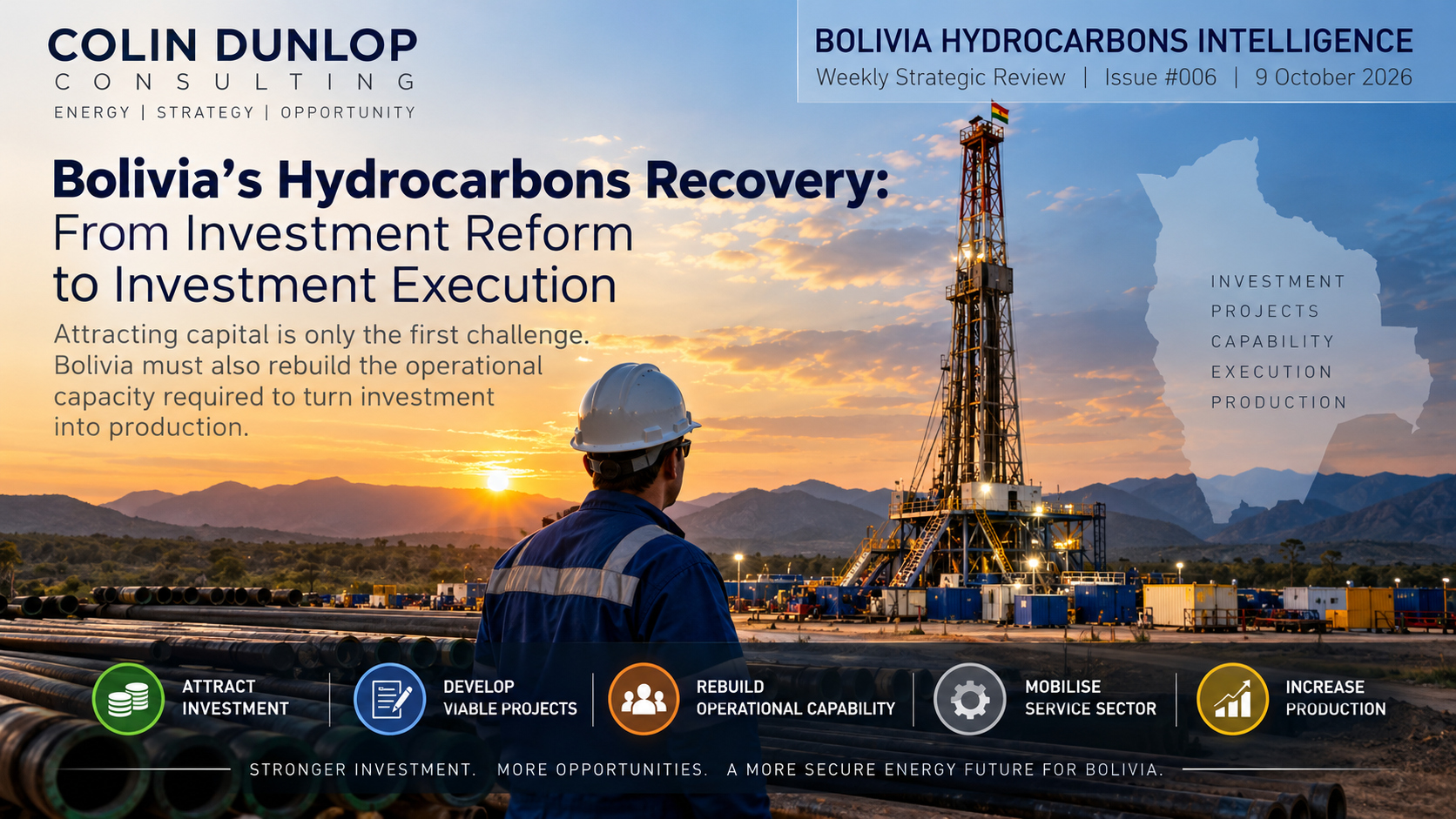
Bolivia Hydrocarbons Intelligence
Weekly Strategic Review | Issue #006 | 9 October 2026
Bolivia’s Hydrocarbons Recovery: From Investment Reform to Investment Execution
Bolivia is beginning to confront the structural barriers to rebuilding its hydrocarbons industry. But attracting capital is only the first challenge. The country must also rebuild the operational capacity required to convert investment into production.
1. The next challenge: Turning investment intentions into production
Bolivia’s hydrocarbons industry is approaching a potentially important transition.
The Government has signalled its intention to reform the legal and commercial framework governing upstream investment. YPFB has identified production recovery, exploration and renewed investor confidence as strategic priorities.
But legislation alone will not restore Bolivia’s hydrocarbons industry.
The country must simultaneously address three interdependent challenges:
- Attract international investment.
- Develop a commercially viable portfolio of upstream projects.
- Rebuild the operational capabilities required to execute those projects.
These challenges cannot be addressed sequentially.
Investors need confidence that projects can be executed. Operators need access to equipment, technology and qualified personnel. Service companies need sufficient visibility of future activity to justify mobilising resources.
The challenge is therefore not simply attracting capital. It is rebuilding an entire investment and execution ecosystem.
2. Bolivia’s investment requirements are substantial
YPFB’s published investment programme for 2026 provides a useful indication of the scale of the challenge.
The company and its subsidiaries, together with existing operators, programmed approximately US$600.8 million of investment for the year.
The planned allocation included:
| Investment category | US$ million |
|---|---|
| Exploration | 282.30 |
| Exploitation | 164.93 |
| Other activities | 153.57 |
| Total | 600.80 |
The distribution by investor was equally revealing.
YPFB’s parent company accounted for approximately 57% of planned investment, its subsidiaries for 28%, and other operating companies for 15%.
In other words, approximately 85% of programmed investment depended on YPFB and its subsidiaries.
These are budgeted amounts, not verified expenditure.
Nevertheless, the figures illustrate an important structural issue.
Bolivia cannot sustainably rebuild its upstream industry if the overwhelming majority of investment continues to depend upon the financial capacity of the national oil company.
A successful recovery will require substantially greater participation from international operators, independent petroleum companies and specialist investors.
Source: YPFB — Investment Programme 2026
3. The opportunity extends beyond major international oil companies
Much of the public discussion surrounding Bolivia’s hydrocarbons reform focuses on attracting large international petroleum companies.
That is understandable.
Major operators bring substantial capital, technical expertise and the ability to develop complex projects.
However, they are not necessarily the most appropriate investors for every opportunity.
Bolivia’s mature and marginal fields may be particularly attractive to smaller, technically focused operators.
These companies frequently specialise in extracting additional value from existing assets through:
- Workovers and recompletions.
- Artificial-lift optimisation.
- Reservoir management.
- Production enhancement.
- Infill drilling.
- Facilities rehabilitation.
Such projects can require substantially less capital than frontier exploration.
They may also generate production and cash flow considerably sooner.
For Bolivia, attracting smaller independent operators could be just as important as persuading major international companies to return.
The objective should not be to attract the largest companies. It should be to attract the right companies for each opportunity.
4. The service industry must recover alongside the operators
One aspect of Bolivia’s hydrocarbons recovery receives insufficient attention.
Even if the country attracts substantial investment, who will execute the work?
At the height of activity following the capitalisation reforms of the late 1990s, Bolivia supported a much larger drilling and oilfield services industry than it does today.
Drilling contractors, well-service companies, equipment suppliers, engineering contractors and specialist service providers maintained significant local capabilities.
As exploration and production activity declined, much of that capacity disappeared or was redeployed internationally.
Rebuilding it will take time.
A sustained increase in drilling and intervention activity would require additional:
- Drilling and workover rigs.
- Well-completion and stimulation services.
- Wireline, coiled tubing and well-testing capabilities.
- Engineering, procurement and construction services.
- Production equipment and artificial-lift systems.
- Qualified technical and operational personnel.
These capabilities cannot necessarily be mobilised immediately.
Equipment may require international transportation, customs clearance and local certification.
Personnel may require recruitment, training and mobilisation.
Service companies will also need confidence that sufficient work exists to justify establishing or expanding their Bolivian operations.
This creates a commercial opportunity for international service providers, particularly companies operating in established oilfield service centres such as Houston and Aberdeen.
However, these companies will need credible evidence of an emerging market before committing significant resources.
5. A pipeline of projects is more valuable than isolated announcements
For international service companies, a single drilling contract rarely justifies a major market-entry investment.
A credible multi-year programme is considerably more attractive.
Consider two hypothetical scenarios.
Scenario A: Isolated activity
An operator announces one exploration well.
A drilling contractor must evaluate mobilisation costs, equipment availability, local operating requirements and the likelihood of securing additional work.
The economics may be unattractive.
Scenario B: Coordinated activity
Several operators identify a combined programme involving exploration wells, development drilling, workovers and production-enhancement projects.
Service companies can evaluate the opportunity as a portfolio.
Equipment utilisation improves.
Mobilisation costs can be spread across multiple projects.
Local employment and infrastructure become more economically viable.
The probability of attracting international contractors increases.
The lesson is straightforward.
Bolivia needs a visible, credible and coordinated pipeline of upstream activity.
This does not require all operators to share commercially sensitive information.
It does require sufficient transparency regarding anticipated activity, project schedules and service requirements to allow the supply chain to prepare.
6. Existing projects provide a foundation
Bolivia is not starting from zero.
YPFB’s current programme already contains examples of the different activities required for recovery.
The Junín-9D project, launched in August with an estimated investment of US$6.4 million, illustrates continued development of existing gas resources.
The Surubí Noroeste-6 project represents another development opportunity.
At Montecristo-9, YPFB Chaco is evaluating specialised completion and stimulation technology in low-permeability Devonian reservoirs.
Meanwhile, mature-field intervention programmes demonstrate the potential for incremental production recovery from existing assets.
These projects are different in scale, technical complexity and commercial risk.
But collectively, they illustrate the diversity of work that could support a broader recovery programme.
The critical next step is converting individual activities into a sustained and expanding programme.
Source: YPFB — Junín-9D
Source: YPFB — Montecristo-9
7. Investment reform must address the entire project lifecycle
The proposed hydrocarbons reforms discussed in Issue #005 represent an opportunity to address long-standing investment barriers.
However, reform should not be limited to fiscal incentives or contractual approval.
International investors evaluate the entire project lifecycle.
That includes:
Entry: Can a company establish operations, acquire interests and negotiate commercially viable contracts?
Approval: Are regulatory procedures transparent, predictable and timely?
Financing: Can investors deploy capital, access foreign exchange and repatriate legitimate returns?
Execution: Can equipment, technology and qualified personnel be mobilised efficiently?
Operations: Are transportation, processing infrastructure and commercial arrangements reliable?
Exit: Can an investor transfer or sell its interests under clearly defined rules?
A weakness in any one of these areas can undermine an otherwise attractive opportunity.
This is particularly important for smaller independent operators, which generally have fewer resources available to navigate prolonged administrative uncertainty.
8. What would demonstrate genuine progress?
Announcements of reform, investor meetings and expressions of interest are useful indicators of direction.
But they do not necessarily represent investment.
More meaningful indicators would include:
First: Publication of commercially competitive contractual and fiscal terms.
Second: Execution of binding agreements with credible operators and investors.
Third: Approval and financing of specific upstream projects.
Fourth: Mobilisation of drilling rigs, well-service equipment and technical personnel.
Fifth: Measurable increases in production and, eventually, independently certified reserves.
These are the milestones that international investors and service providers will monitor.
They are also the milestones against which Bolivia’s hydrocarbons recovery should ultimately be judged.
Strategic implication
Bolivia’s hydrocarbons recovery presents an opportunity extending well beyond exploration and production companies.
It potentially creates demand for an entire supporting industry.
International drilling contractors, engineering companies, equipment suppliers and specialist oilfield service providers could all participate.
However, successful market entry will depend upon understanding the country’s evolving legal framework, identifying credible operators and projects, evaluating commercial risks and establishing appropriate local relationships.
For companies considering entering Bolivia, early positioning may provide advantages.
But early positioning should be based on informed assessment rather than speculation.
The most attractive opportunities will emerge where credible projects, competitive investment terms and operational capabilities converge.
What to watch next
Hydrocarbons legislation: Publication of the proposed legislation and the specific contractual and fiscal mechanisms intended to attract investment.
Mature-field rehabilitation: Evidence that individual well interventions are developing into larger, commercially structured programmes.
Montecristo-9: Production-test results and evidence supporting—or challenging—the potential for repeatable commercial development.
International participation: Binding agreements, farm-ins and investment commitments involving external capital.
Service-sector mobilisation: New drilling contracts, equipment mobilisation, local partnerships and expansion of specialist oilfield services.
Conclusion
Bolivia’s hydrocarbons recovery cannot be achieved through legislation alone.
Nor can it depend exclusively upon YPFB’s investment capacity.
The country needs a coordinated expansion of private investment, commercially attractive projects and operational capability.
That means creating opportunities not only for major international petroleum companies, but also for independent operators, specialist investors and the international oilfield services industry.
The proposed reforms could help establish the necessary investment environment.
But the real transformation will begin when capital commitments become drilling programmes, intervention campaigns, equipment mobilisation and additional production.
Bolivia’s next hydrocarbons challenge is not simply attracting investment. It is creating the conditions to execute it.
Resumen en español
La recuperación del sector hidrocarburífero boliviano requiere mucho más que una nueva legislación.
El país necesita atraer inversión privada, desarrollar una cartera de proyectos comercialmente viables y reconstruir la capacidad operativa necesaria para ejecutarlos.
El programa de inversiones de YPFB para 2026 contemplaba aproximadamente US$600,8 millones, de los cuales alrededor del 85% correspondía a YPFB y sus empresas subsidiarias.
Esta concentración demuestra la importancia de atraer mayor participación de operadores privados e inversionistas internacionales.
Sin embargo, la oportunidad no se limita a las grandes compañías petroleras.
Los operadores independientes especializados en campos maduros, las empresas de perforación, los proveedores de servicios petroleros y las compañías de ingeniería también podrían desempeñar un papel fundamental.
Para atraerlos, Bolivia necesitará ofrecer condiciones comerciales competitivas, procedimientos regulatorios previsibles y una cartera creíble de proyectos que justifique la movilización de equipos, tecnología y personal especializado.
La verdadera prueba de la reforma será la conversión de compromisos de inversión en proyectos ejecutados y producción adicional.
La recuperación de los hidrocarburos bolivianos dependerá tanto de la capacidad de atraer capital como de la capacidad de ejecutarlo.
Bolivia Hydrocarbons Intelligence is an independent intelligence and analysis publication from Colin Dunlop Consulting, focused on the developments shaping Bolivia’s hydrocarbons sector, investment environment and upstream opportunities.
Colin Dunlop | Petroleum Engineer & Project Manager | Santa Cruz, Bolivia
Sources
- YPFB — US$600.8 million hydrocarbons investment programme for 2026 — 30 April 2026.
- YPFB Andina — US$71.6 million investment programme — 30 April 2026.
- YPFB — Junín-9D drilling programme — 28 August 2026.
- YPFB — Montecristo-9 completion and production testing — 15 September 2026.
- Ministry of Hydrocarbons — Proposed reforms to accelerate exploration and production contracts — 12 November 2024.